It’s time for the battle of two popular ETFs, VOO versus VOOG but which is better?
Investing in exchange-traded funds (ETFs) is a popular way to diversify a portfolio, and Vanguard offers two standout options: VOO (Vanguard S&P 500 ETF) and VOOG (Vanguard S&P 500 Growth ETF).
Both are tied to the S&P 500, but they cater to different investment strategies. Let’s break down the key differences to help you decide which ETF aligns best with your financial goals.
Vanguard ETFs Video Overview
VOOG: Vanguard S&P 500 Growth ETF
The Vanguard S&P 500 Growth ETF (VOOG) focuses on investing in stocks from the Standard & Poor’s 500 Growth Index.
This index comprises companies classified as growth stocks within the S&P 500, offering investors exposure to firms with higher potential for growth compared to value-focused counterparts.
- Management Style: VOOG is passively managed to closely track the returns of its underlying index. By mirroring the S&P 500 Growth Index, the fund offers a reliable gauge of overall U.S. growth stock performance.
- Asset Category: Large Growth
- YTD Return: 37.03%
- Earnings Growth Rate: 26.8% (The annualized percentage change in earnings per share (EPS) over time, indicating VOOG’s holdings are positioned for growth, aligning with the fund’s strategy.)
Investment Suitability
VOOG is most suitable for long-term investors seeking high growth potential.
The fund’s holdings, concentrated in large-cap growth stocks, align well with investors prioritising capital appreciation over dividend income.
VOOG’s low expense ratio enhances cost-efficiency, and its focus on established market leaders provides stability amidst market volatility.
Risks
Volatility: Growth stocks, which dominate VOOG’s portfolio, can be highly volatile, especially during market corrections.
Sector Concentration: Heavy exposure to technology and consumer discretionary sectors increases susceptibility to sector-specific downturns.
Technical Analysis
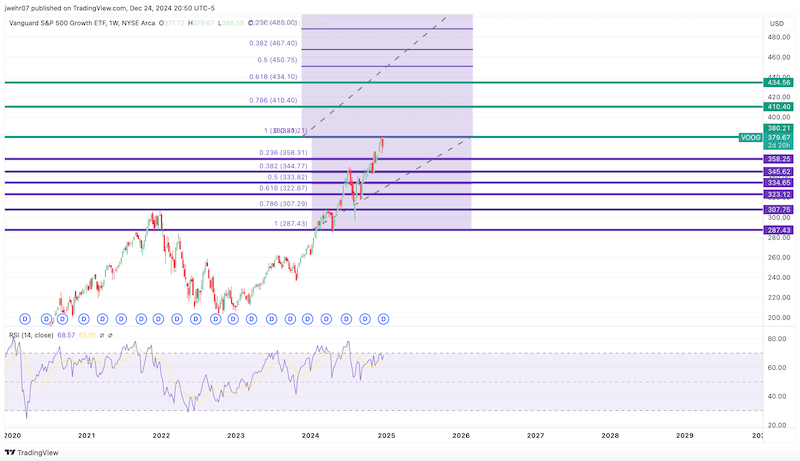
VOOG has reached an all-time high, with the RSI currently elevated at 67.67, indicating strong momentum.
The cloud analysis and overall market sentiment both suggest a bullish outlook. Current market price (CMP) may be worth considering:
- Buy Limit Order Ideas: 358.25, 345.62, 334.65
Remember: Investing is personal, and what is right for me might not be right for you. Always do your own due diligence. You should ONLY invest based on your own risk tolerance and your timeframe for reaching your portfolio goals.
VOO: Vanguard S&P 500 ETF
The Vanguard S&P 500 ETF (VOO) invests in the 500 largest U.S. companies included in the S&P 500 Index, providing investors with broad exposure to the U.S. equity market.
This ETF closely tracks the performance of its benchmark index through full replication, holding all stocks in the same proportions.
It is an exchange-traded share class of the Vanguard 500 Index Fund, with a passive management style that ensures low expenses and efficient tracking.
- Management Style: VOO is also passively managed to replicate the S&P 500 Index, offering investors a cost-efficient and diversified investment option.
- Asset Category: Large Blend, combining both growth and value stocks to deliver balanced exposure.
- YTD Return: 25.44%
- Earnings Growth Rate: 19.7% (This reflects the weighted average growth rate of earnings for the companies within the fund.)
Investment Suitability
VOO is best suited for long-term investors seeking diversified exposure to U.S. large-cap stocks with a focus on capital growth. Its low expense ratio and passive management style provide cost-efficient access to the broader U.S. stock market. VOO’s high liquidity ensures ease of trading, and its broad diversification helps mitigate company-specific risks.
Risks
Overvaluation: VOO’s heavy concentration in AI-driven mega-cap stocks, such as Apple, NVIDIA, and Microsoft, has raised concerns about overvaluation.
Interest Rate Uncertainty: Persistently high inflation may limit the Federal Reserve’s ability to cut interest rates as expected, potentially impacting overall market performance and the fund’s returns in 2025.
Technical Analysis
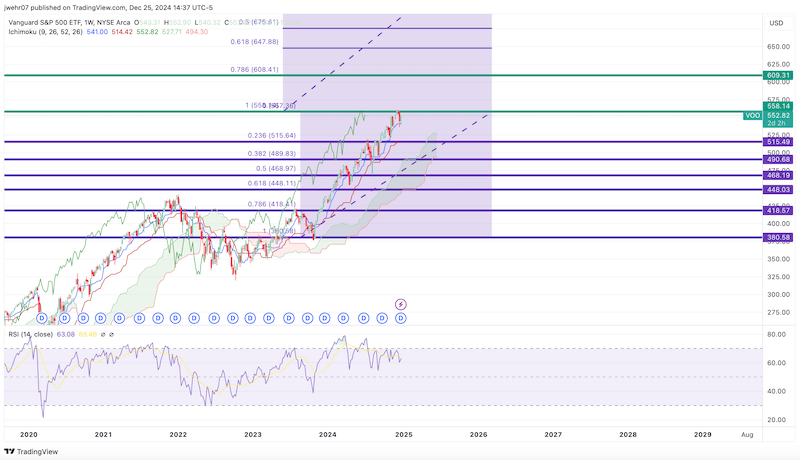
VOO’s strong performance has pushed it toward all-time highs, reflecting strong momentum. Indicators such as RSI suggest potential overbought conditions, making dollar-cost averaging (DCA) a potential strategy. Investors may consider entering at the current market price (CMP) while setting buy limits (BLs) to take advantage of potential dips.
- Buy Limit Order Ideas: 552.82 (CMP), 515.49, 490.68, 468.19
Remember: Investing is personal, and what is right for me might not be right for you. Always do your own due diligence. You should ONLY invest based on your own risk tolerance and your timeframe for reaching your portfolio goals.
Summary
Both VOO and VOOG offer distinct advantages based on your investment goals:
- VOO provides balanced exposure to growth and value stocks, making it ideal for diversification and long-term stability.
- VOOG focuses on high-growth sectors, offering more potential for returns but with increased volatility.
VOO may suit investors looking for a steady, broad-market approach, while VOOG could appeal to those seeking higher growth potential and are comfortable with increased risk.
A dollar-cost averaging (DCA) strategy can help mitigate risks for either choice.
Are You Ready to Learn How to Successfully Compound Your Investments?
Do you want to learn how to analyse assets that align with your unique risk tolerance and financial goals? Are you interested in mastering the proven 5-Step Invest Diva Diamond Analysis strategy and the Triple Compounding™ method I use?
Register for your FREE Triple Compounding™ Training HERE AND get Kiana’s Triple Compounding™ workbook and personal risk management toolkit for FREE. Both available at no cost to you.
If you enjoyed my blog post about VOO Versus VOOG – Which Is Better For Your Portfolio? you’ll love my post on ‘AbbVie Stock Price Analysis.’
Disclosure: I am not a financial advisor and this is not financial advice. This information is for educational purposes only. This post ‘VOO Versus VOOG – Which Is Better For Your Portfolio?’ may contain affiliate links, meaning I get a commission if you decide to make a purchase through my links, at no cost to you. Please see terms of service page for more information.

Jes provides Premium Coaching Services for Invest Diva. This includes delivering live weekly coaching sessions and analysis for members of the Invest Diva Premium Investing Group. Jes is also a published author with Seeking Alpha.