Oracle is one of the biggest names in enterprise software and cloud services. They power databases used by governments, banks, hospitals, airlines, and global corporations. For years they were known for steady tech growth, not big surprises.
Then something wild happened.
Only two months ago Oracle stock was flying. Analysts cheered. AI deals stacked up. The company felt like it had finally stepped into a new era.
Now the mood has flipped.
Debt worries. AI capex questions. Market whiplash. And investors wondering if this massive story is just getting started or coming apart at the seams.
So before jumping to conclusions, let’s slow down and see what is really happening beneath the headlines. This is where the IDDA framework comes in. It helps you understand a company from all angles so you can decide if it fits your goals and your risk comfort.
The IDDA Analysis framework is used to analyze companies and determine which are right for you. There are five steps to the process:
- Capital Analysis – Your personal risk tolerance.
- Intentional Analysis – Your unique financial goals and timelines based on your age, health, and lifestyle.
- Fundamental Analysis – The viability of the asset based on company performance, financial health, and market position.
- Sentimental Analysis – The current emotions of Wall Street and other market participants.
- Technical Analysis – Historical price action to identify key psychological levels and market patterns.
Let’s dive into the IDDA analysis to assess Oracle’s fundamental, sentimental, and technical outlook.
IDDA Point 1&2: Capital & Intentional
The capital and intentional analysis need to be conducted by you.
Select your assets in alignment with your financial goals. Listen to your intuition about each asset, but remember to invest based on your own values, not just because of recommendations from others.
Don’t know your risk tolerance? Get Kiana Danial’s risk management toolkit for free here.
IDDA Point 3: Fundamental
🔷 Strong cloud and AI growth
Oracle grows its cloud business fast and its AI infrastructure deals pushed revenue higher this year. Big customers like OpenAI, xAI, Meta, Nvidia, and AMD bring attention and long term demand. This helps Oracle stay relevant in the AI race and supports future growth.
🔻 Heavy debt and weak free cash flow
Oracle spends more money than it brings in right now. Free cash flow is negative and debt is at levels that make investors nervous. The company may need more borrowing to finish its AI data centers. This adds pressure and limits flexibility.
🔻 High dependence on OpenAI
A large part of Oracle’s future revenue comes from OpenAI contracts. This creates concentration risk if OpenAI slows down, faces competition, or changes its plans. One customer should not have this much weight on the business.
🔻 Legacy segments are flat
Older businesses like software licenses, hardware, and services are not growing. These parts used to support the company but now move sideways. This means Oracle depends more on cloud and AI to carry the whole business.
🔷 Long term revenue targets
Oracle aims for strong revenue growth by 2030. Management believes cloud and AI can push the company to more than double today’s sales. If execution stays on track, this gives the stock long term potential.
🔷 Strong demand for data centers
The whole AI industry needs more computing power. Oracle builds large scale data centers to meet that demand. This industry trend supports future bookings and reinforces Oracle’s place in AI infrastructure.
🔻 Earnings boosted by accounting choices
EPS looks strong but part of that comes from extending asset lifetimes to reduce depreciation. Cash flow does not match these earnings. This makes EPS less reliable as a measure of real performance.
Fundamental risk: High
IDDA Point 4: Sentimental
Overall sentiment is mixed for Oracle.
Strengths
✅ Investor excitement around Oracle’s fast cloud and AI growth keeps interest high. Many investors still see Oracle as a new player in the AI infrastructure race. This creates hope that the stock can recover when fear settles.
✅ Big contracts with OpenAI, xAI, Meta, Nvidia, and AMD support the belief that Oracle can stay relevant in the AI boom. These names create confidence even when the numbers look heavy.
✅ Management keeps guiding for strong long term revenue growth. Their public comments show optimism about cloud demand, AI infrastructure, and long term earnings. This gives investors a reason to stay positive.
✅ Analysts remain divided but many still expect long term growth. Upgrades from major institutions earlier in the year help keep sentiment from collapsing.
Risks
❌ Fear is rising because of Oracle’s heavy debt and negative free cash flow. Credit markets are more nervous than stock investors. Rising CDS prices show growing doubt about risk.
❌ Sentiment weakened after the 40 percent drop. Many investors feel burned by the giant post earnings rally earlier in the year. The reversal created hesitation and distrust.
❌ Concentration risk around OpenAI increases emotional pressure. If OpenAI slows down or funding becomes harder, investors may panic because so much of the RPO depends on one partner.
❌ Market discussions focus on whether Oracle took on more than it can handle with data center buildouts. Concerns about execution and cash needs create a bearish tone.
❌ Tech macro uncertainty and high interest rates make investors cautious. When markets feel risk averse, companies with high spending get punished twice as hard.
Sentimental risk: High
Want our top stock picks and analysis every month? Get Our Monthly Newsletter and get Kiana’s Hot Picks and our top strategies

IDDA Point 5: Technical
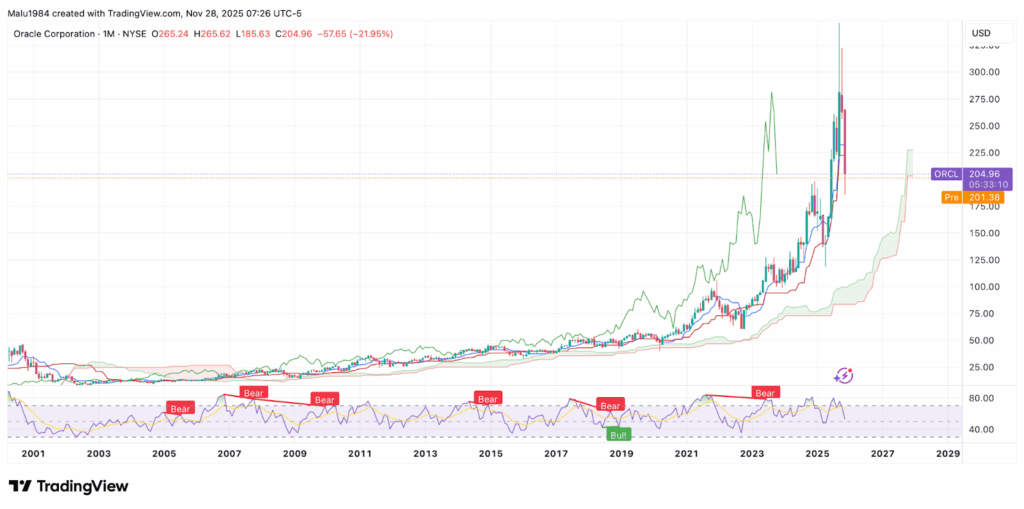
Monthly:
🟢 Price stays above the Ichimoku cloud
Candles sit above the cloud, which keeps the long term trend bullish. The cloud ahead is green, so momentum still leans positive.
🟢 Conversion line above baseline
The fast line is still above the slow line. This shows buyers still have control on the higher time frame.
🟢 RSI at 52
RSI sits in the middle. There is no overbought or oversold pressure here. This keeps the monthly chart neutral and stable.
Weekly Chart
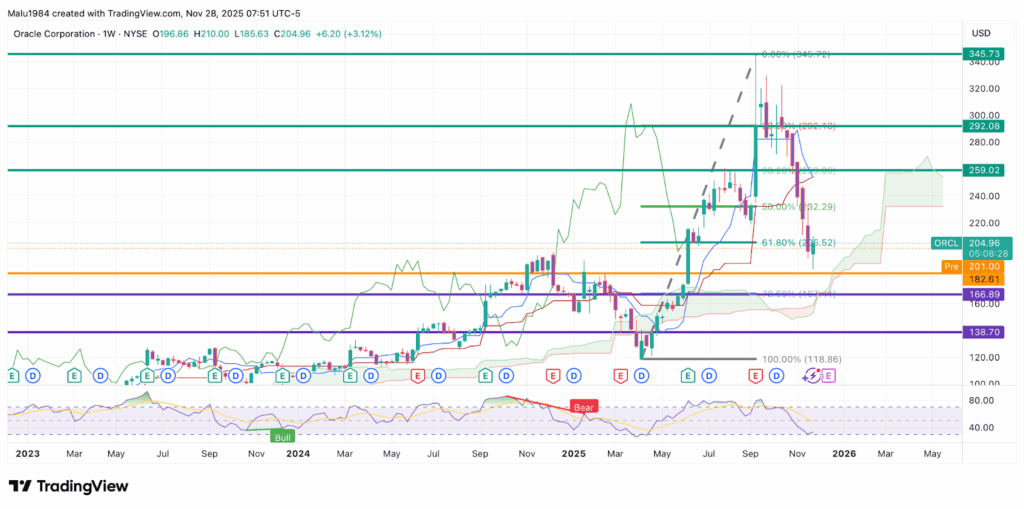
🔶 Ichimoku cloud still bullish but losing strength
Price is above the cloud, which keeps the trend positive. The worry is that the conversion line is getting close to the baseline. If it crosses down, it forms a dead cross. That would be a bearish warning for the short term.
🟢 RSI bullish divergence
Price made lower lows in the last two weekly candles but RSI made higher lows. When price drops and RSI rises, it shows selling pressure is slowing down. This often signals a possible reversal.
🔶 Fibonacci retracement at the 61.8 level
The drop has reached the 61.8 percent level of the full move up. This level is known for strong reactions and can act as support. Many reversals start here.
🔶 Price reactions similar to the April drop
Even though the recent drop is larger in dollars, both drops pushed RSI to around the same level. This shows the market reacts to percentage loss in momentum, not the size of the candle.
Overall technical outlook
Oracle stays bullish on the monthly chart but looks shaky on the weekly. The cloud still supports the trend and RSI shows signs of a bounce. The price sits on a strong Fibonacci support. A reversal is possible if the conversion line holds above the baseline. A dead cross would delay the recovery.
Buy Limit (BL) levels:
📌 $182.61 (High Fill Probability)
📌 $166.89 (Moderate Fill Probability)
📌 $138.70 (Low Fill Probability)
Profit Taking Levels (PTs)
🎯 $259.02 (High Fill Probability)
🎯 $292.08 (Moderate Fill Probability)
🎯 $345.73 (Low Fill Probability)
Here are the Invest Diva ‘Confidence Compass’ questions to ask yourself before buying at each level:
- If I buy at this price and the price drops by another 50%, how would I feel? Would I panic, or would I buy more to dollar-cost average at lower prices? (hint: this question also reveals your CONFIDENCE in the asset you’re planning to invest in).
- If I don’t buy at this price and the stock suddenly turns around and starts going up again, will I beat myself up for not having bought at this level?
Remember: Investing is personal, and what is right for me might not be right for you. Always do your own due diligence. You should ONLY invest based on your own risk tolerance and your timeframe for reaching your portfolio goals
Technical risk: Medium to High
Summary: Final Thoughts
Oracle sits in a strange place right now. The stock had a big run earlier in the year and then fell more than forty percent. The drop was fast and emotional. A big reason is fear around debt, negative free cash flow, and how much Oracle must spend to build AI data centers. These are real issues and they add pressure to the long term story.
On the fundamental side, cloud and AI growth are strong. Big customers and big demand help the bull case. But heavy debt, reliance on OpenAI, and weak cash flow create real risk. Oracle must prove it can turn these big contracts into real profit.
On the sentimental side, the market is mixed. Some investors still believe in long term growth. Others feel worried about debt and future spending. Credit markets show more fear than the stock market. This tells us investors are not aligned on what comes next.
On the technical side, the weekly chart shows the price at a major support area and the RSI has a bullish divergence. The ichimoku cloud is still supportive but it is not safe. A small move can shift the trend. The stock sits at the 61.8 retracement level, which often brings bounces.
Overall, Oracle is at a turning point. This drop can be a setup for long term growth or a sign that more weakness is coming. The next earnings and debt updates will shape the path.
Overall risk: High
Want to become a self sufficient Triple Compounder who no longer needs to read this blog?
Attend this free Triple Compounding Training here 👇👇

If you enjoyed my blog post about Oracle (ORCL), you’ll love my post on CrowdStrike stock (CRWD): The move no one is talking about but everyone should watch.
Disclosure: I am not a financial advisor, and this is not financial advice. This information is for educational purposes only. This post about Oracle (ORCL) may contain affiliate links, meaning I get a commission if you decide to make a purchase through my links, at no cost to you. Please see the terms of service page for more information.

Invest Diva Premium Coach, $100K+ portfolio award winner, mom of 3. Increased family net worth from $200K in 2020 to $500K+ in 2024.