Does the upcoming presidential election have you worried about how to protect your investment portfolio in an election year? You’re not alone! While candidates run for election, the stock market can simultaneously run the risk of increased volatility.
Add global tensions and high interest rates to the equation… what’s an investor to do to ensure they are taking the necessary steps to limit volatility in their portfolio?

In this post, we will explore market performance in an election year, the current political and economic climate, and concrete actions you can take to protect your investment portfolio in an election year and beyond.
Table of Contents: How to Protect Your Investment Portfolio in an Election Year
- Historical Election Year Impact on the Stock Market
- Key Policy Issues that can Create Volatility
- The Current Climate Beyond the Election
- Tips to Safeguard Your Investment Portfolio
Historical Election Year Impact on the Stock Market
To make our best “educated guess” (in lieu of a crystal ball) as to how markets will continue to perform during this presidential election year, let’s start by examining the stock market’s past performance during election years.
Leading off with the good news: Going back to the 1950s, the stock market has seen a negative yearly return only THREE TIMES during an election year, in 1960, 2000 and 2008. From a simple statistical perspective, that’s a positive sign.
The not-so-good news: Past performance is not indicative of future results.
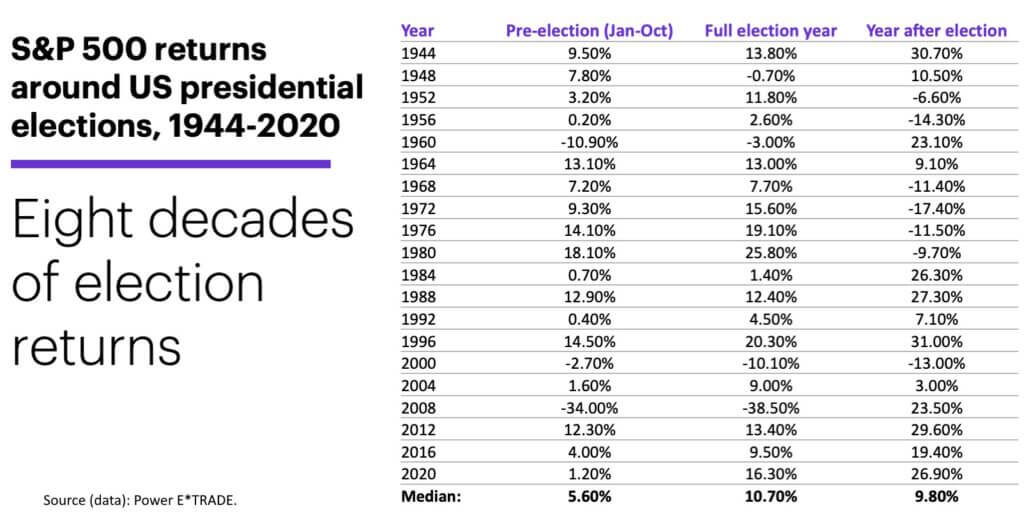
Furthermore, the Presidential Election Cycle Theory developed by Yale Hirsch’s “Stock Trader’s Almanac” has data going back to 1833 that attempts to draw relationships between the four-year presidential cycle and the stock market.
The result, according to his research, is that the third year of a presidency typically overlapped with the strongest yearly market gains.
Let’s put that to the test for the third year of Biden’s presidency. In 2023, the stock market saw a 26% gain after an 18% loss in 2022. Of course, we also saw a pandemic with an impact on the worldwide economy that could skew data in a way that hasn’t been explored fully.
Thus far for 2024, (at the time of publication) we’re tracking at around an 18% return. Hirsch’s theory also uncovered that the chance of a positive market return during year four of a presidential term is 83%. That’s another tally mark in the “positive” column for this election year.
Key Policy Issues that can Create Volatility
When thinking about how to protect your investment portfolio in an election year, history is only one factor that we can point to for future market return speculation. Another important factor is the multitude of policy issues that our presidential candidates will need to weigh-in on, many of which can be pivotal to their platform and performance.
Tax policies are huge issues for voters, debates and our candidates. Without getting into the weeds on this topic, voters and investors will certainly be looking for guidance on candidate tax policies but it’s important to remember that markets have performed well across both high and low tax periods.
Other issues for consideration include spending priorities and, more importantly, unprecedented national debt of $34 trillion and counting. Add to that basket of key issues healthcare policy, immigration policy, and geopolitical conflicts and you can understand the fine line investors must walk to ensure their investment portfolio is protected.
Despite this growing list of (daunting) issues, it is important that investors remain focused on factors like economic growth, corporate earnings and inflation when managing their portfolios.
The Current Climate Beyond the Election
There’s no denying that we’re in a bull market currently. We have a few additional items in our back pocket to look forward to this election year – the primary focus being on the expectation that the Fed will begin to lower interest rates at some point this fall. The Fed lowering rates is a positive factor for not just the economy but the markets as well.
Many analysts anticipate that rates cuts will bolster U.S. markets as historically, interest rates and the stock market have an inverse relationship. That is to say that when interest rates fall, markets rise, and bonds become less attractive to investors.
I personally believe the Fed has done a worthy job of towing a very thin line of keeping the economy boosted, keeping investor confidence high, while also ensuring that nothing “breaks” in a catastrophic way within the markets or economy at large.
Tips to Safeguard Your Investment Portfolio
Now that you are armed with the historical and policy impacts during an election year, let’s dive into some actionable strategies that you can take to protect your portfolio in an election year and beyond.
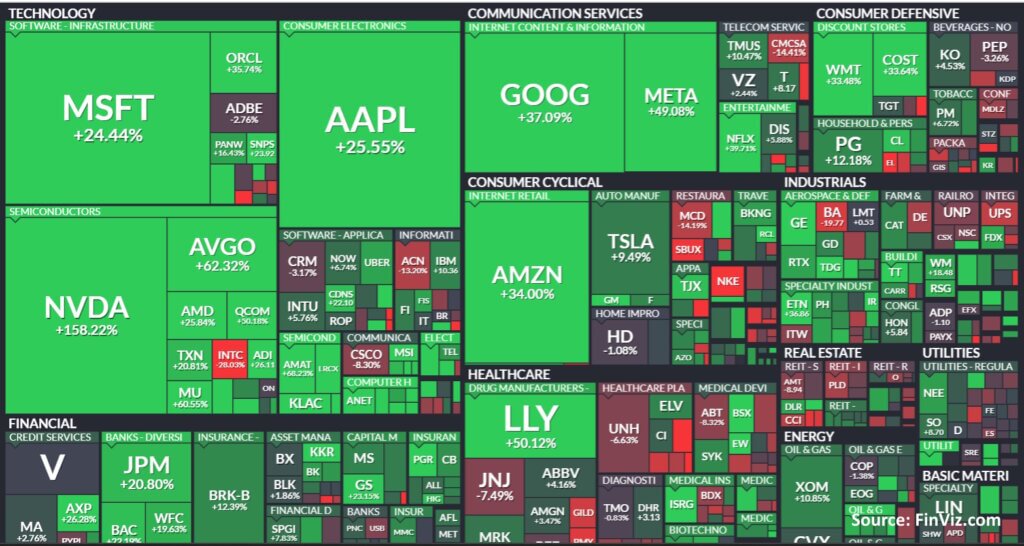
The #1 strategy to employ is portfolio diversification. According to the Global Industry Classification Standard (GICS), there are 11 market sectors including Technology, Consumer Discretionary, Consumer Staples and Financials, to name a few of the largest sectors by market cap.
An excellent free, visual resource to explore the various sectors is FinViz.com, where you will find a “heatmap” of the S&P 500 stocks delineated by market sector with performance returns over a given period of time.
When I first started with the Invest Diva Triple Compounder System and my investing journey, I utilized FinViz to ensure that I had an element of diversification within my portfolio across various market sectors. Portfolio diversification can eliminate over-exposure to any one element of risk.
Why is this important? Market sectors can move independently based on the political and economic issues outlined above. As an example, hedges against inflationary periods can include a shift from bonds to stocks, looking at investment opportunities outside of the U.S., growth stocks, real estate and gold and other commodities.
A deflationary environment hedge can include defensive stocks, dividend-paying stocks, investment-grade bonds and cash. Bottom line: diversification is your friend in any environment and can give you an added peace of mind when considering how to protect your portfolio in an election year.
IMPORTANT: Any diversification strategy that you put to use in your stock portfolio should align with your specific risk tolerance and investment strategy. Understanding and honoring your risk tolerance is always the priority when building your ideal portfolio and protecting your investment portfolio in an election year.

Conclusion
As an educated investor, it is paramount that you don’t try to anticipate election outcomes. In lieu of a crystal ball, the best strategy is to develop your own personal strategy, maintain a proper perspective and control the things that you can control. Moving investments or changing your strategy based on political news is not recommended.
While we have the historical knowledge to better understand how markets perform during an election year and through the four-year presidential term, it has been found that election outcomes don’t significantly affect market performance.
In addition to a presidential election year, we have elements such as an existing strong bull market, the potential for the Fed to start lowering interest rates and a shifting geopolitical climate to take into consideration.
Personally, my investment strategy for how to protect my investment portfolio in an election year has not shifted this year but rather my focus remains on fundamental, technical and sentimental analysis that are the key tenants of the Invest Diva Triple Compounder System and making smart, sustainable investment decisions.
If you’re an investor seeking assistance in determining your risk tolerance and creating a personalized strategy just like I have, the free “Triple Compounding” training is an excellent resource.
This comprehensive and free Triple Compounding™ training offers valuable insights and practical strategies tailored to your financial goals and risk profile. To take advantage of this opportunity and enhance your investing knowledge, click here to register now.
Cheers to investing in this election year and beyond!
Your Invest Diva Platinum Coach,
Tonya
Disclosure: I am not a financial advisor and this is not financial advice. This information is for educational purposes only. This post ‘How to Protect Your Investment Portfolio in an Election Year’ may contain affiliate links, meaning I get a commission if you decide to make a purchase through my links, at no cost to you. Please see terms of service page for more information.

Tonya provides high level Platinum Coaching Services for Invest Diva. She is also a $1 Million Dollar Portfolio Award Winner having accelerated her portfolio to this level over the past 3 short years.