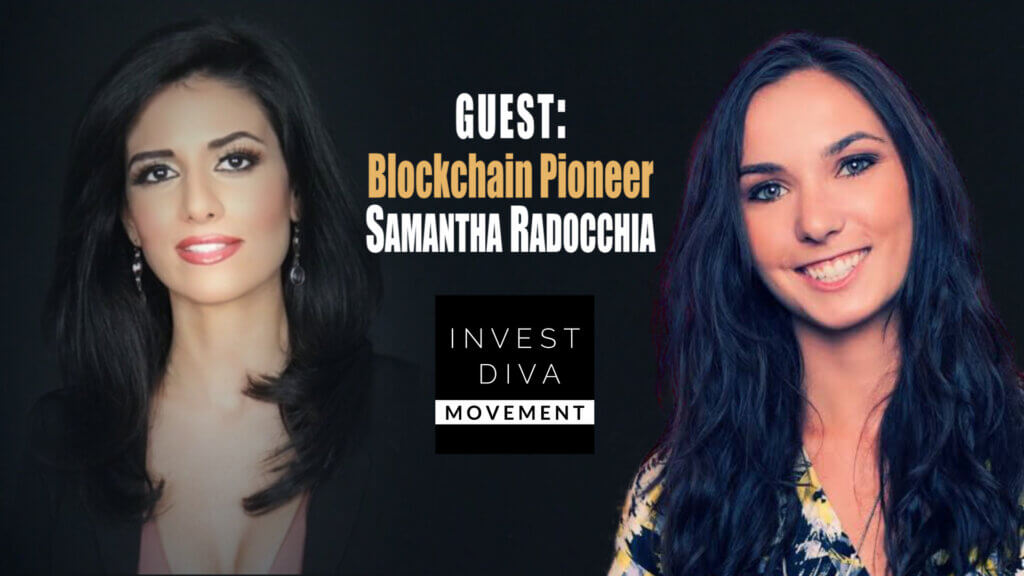
Samantha Radocchia (Sam Rad) is the author of the book “Bitcoin Pizza”. Her recent project, Mediledger focuses on blockchain pharma supply chain.
As a blockchain pioneer and advocate who combines the mindsets of an anthropologist and a technologist. She’s led corporate trainings at Fortune 100 companies, governments, and the United Nations, educating leaders on the technologies and cultural shifts that will shape their organizations–and daily lives–in the decades to come. Sam is a contributor to Forbes and was named to their 30 Under 30 List in 2017.
How To Start, Manage, & GROW Your Online Investment Portfolio
(Even if you’re not a math whiz, don’t have a ton of extra cash, and busy juggling life & kids. )
A three-time entrepreneur, Sam holds several patents and is a cofounder of Chronicled, an enterprise blockchain company focused on Driving the future of enterprise supply chains and blockchain pharma supply chain.
Her MediLedger Project was started in 2017 to bring together leading Pharmaceutical Manufacturers and Distributors to explore blockchain technology to meet track and trace regulations, and to provide a step function improvement in the overall operation of the supply chain.
In this Invest Diva’s episode of Diva on the Block, Kiana Danial and Samantha Radoccia chatted about the following topics, including her book, Bitcoin Pizza.
How to Start, Manage, & Grow Your Online Investment Portfolio (Even If You’re Not a Math Whiz) >>
1) Could This Be The Fifth Industrial Revolution? This unique historical moment represents the convergence not just of multiple technologies, but of new ideas, which will shift thinking from centralized to decentralized, opaque to transparent, siloed to open, reactive to proactive, and regulated to self-enforcing. The last time in human history we saw so significant a shift was the Paleolithic revolution when humans took the evolutionary step of making and welding tools.
2) Are You Ready to Trust Blockchain with Everything from your Food to your Finances? Blockchain is a technological manifestation of a social paradigm shift. Its applications go far beyond financial services into industries of all kinds. Blockchain is changing how we are approaching data governance and plays a key element in the convergence of new technologies such as big data, machine learning, AI, additive manufacturing, vertical farming, robotics, biotechnology, and the Internet of Things (IoT).
3) Web 2.0 brought us social networks and cloud servers, but also opened up the floodgates for counterfeiting, diversion and greenwashing. As convenient as two-sided, web-enabled markets may be, they also open up opportunities for and problems with counterfeiting or diversion. The “fresh,” “organic” shampoo you are currently buying from an online retailer may have been sitting on the shelf for a year or longer. The lettuce you buy from that premium-branded grocery store might have listeria or E. coli. Blockchain technology, on the other hand, can establish a “chain of custody” that guarantees none of this will be a problem.
How To Start, Manage, & GROW Your Online Investment Portfolio
(Even if you’re not a math whiz, don’t have a ton of extra cash, and busy juggling life & kids. )
4) The future demands a new operating system that doesn’t operate on trust: a trustless system. Enter: Blockchain. Blockchain technology is very much a manifestation or result of this erosion of trust. By 2020 Gen Z will make up 40 percent of all US consumers, yet only 10 percent of this generation report trust in the government and corporations. They have come of age in an era of fake news, recessions, and brands greenwashing their products and making baseless claims for marketing purposes. They have seen the dark side of global connectivity and the trust gap it causes. In order for companies to stay competitive in this changing landscape, they need to invest in solutions to establish trust with Gen Z.
5) Decentralizing Organizations: What is the Future of Work in a Distributed World? As decentralizing technologies such as blockchain, AR/VR and cooperative communities start to play a bigger role in our lives, we’re seeing an exponential shift to distributed teams and workforces. Will these decentralizing technologies eliminate the concept of “work” altogether?

#1 Best Selling Author. Helping you accelerate your retirement with Triple Compounding™ Former engineer on a mission to help 1 million households take control of their finances. Founder & CEO of Invest Diva.